

Introduction: Why a Dog Feeding Guide Matters More Than You Think
One of the most common questions every dog owner asks at some point is simple but important: how much should I feed my dog? You want to do right by your companion, but pet food packaging labels can be confusing, breed differences are real, and puppies, adults, and senior dogs all have very different nutritional needs. Getting it wrong in either direction, too little or too much, can lead to serious health consequences over time.
This complete dog feeding guide is designed to take all the guesswork out of mealtime. Whether you have a tiny Chihuahua or a large Golden Retriever, a bouncy 8-week-old puppy or a calm 10-year-old senior, you will find clear, practical guidance on how much to feed your dog, how often to offer meals, and how to adjust portions as your dog grows and changes. Bookmark this page because you will come back to it every time your dog enters a new life stage.
Understanding Your Dog’s Caloric Needs: The Foundation of Any Dog Feeding Guide
Before you scoop out a bowl of kibble, it helps to understand what drives your dog’s caloric requirements. Every dog is an individual, and several factors determine exactly how many calories they need each day.
Body weight is the most obvious factor, but it works differently than many owners expect. Larger dogs need more calories overall, yet their calorie needs per pound of body weight are actually lower than those of small dogs. A 5 lb Chihuahua may need roughly 200 to 275 calories per day, while a 70 lb Labrador typically needs 1,200 to 1,700 calories, depending on activity level.
Life stage is equally important. Puppies are growing rapidly and require significantly more calories per pound of body weight than adult dogs. Senior dogs tend to slow down metabolically and often need fewer calories to maintain a healthy weight. Pregnant and nursing females have dramatically increased energy demands.
Activity level can shift calorie needs by 20 to 50 percent. A highly active Border Collie who runs for two hours daily needs far more fuel than a relaxed Basset Hound who prefers a slow afternoon stroll. Always factor in your dog’s actual lifestyle when calculating portions, not just the general breed average.
Reproductive status also plays a role. Spayed and neutered dogs tend to have slightly lower caloric requirements than intact dogs, sometimes by 10 to 15 percent. This is a commonly overlooked detail that contributes to post-spay or post-neuter weight gain if feeding amounts are not adjusted.
The Dog Feeding Chart: Portions by Weight
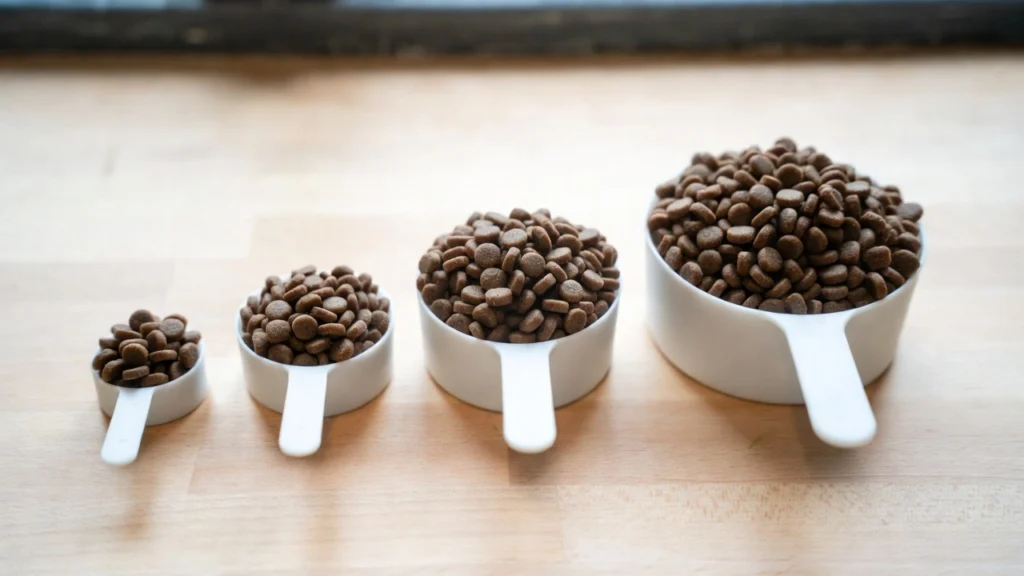
A dog feeding chart gives you a reliable starting point. The values below are general guidelines for an average adult dog eating a standard dry kibble with roughly 350 to 380 calories per cup. Always cross-reference with the specific food your dog eats, since calorie density varies significantly between brands.
- 5 to 10 lbs (toy breeds): 1/3 to 1 cup per day
- 11 to 25 lbs (small breeds): 1 to 1.75 cups per day
- 26 to 50 lbs (medium breeds): 1.75 to 2.75 cups per day
- 51 to 75 lbs (large breeds): 2.75 to 3.5 cups per day
- 76 to 100 lbs (large to giant breeds): 3.5 to 4.5 cups per day
- Over 100 lbs (giant breeds): 4.5 cups plus 1/3 cup for every additional 10 lbs
Remember, these are starting points. Monitor your dog’s body condition score weekly and adjust up or down by 10 percent increments until you find the sweet spot for their individual metabolism. You should be able to feel your dog’s ribs easily with light pressure, but not see them prominently from across the room.
Dog Feeding Guide: Getting the First Year Right

Puppies have unique nutritional needs, and following a solid dog feeding guide during the first year sets the foundation for a lifetime of good health. Puppies generally need about twice the calories per pound of body weight compared to adult dogs, and they require food specifically formulated for growth, with higher protein and calcium levels.
From 6 to 12 weeks of age, puppies should be fed four times daily. From 3 to 6 months, three meals per day is appropriate. After 6 months, most puppies transition well to two meals per day, which is the schedule most adult dogs follow for life.
Large and giant breed puppies need special attention. Feeding them too much too fast can cause bones and joints to develop too quickly, leading to orthopedic problems like hip dysplasia. For large breed puppies, choose a food specifically formulated for large breed growth and avoid overfeeding even if your puppy seems hungry. Controlled, steady growth is the goal, not maximum growth rate.
Small breed puppies face the opposite risk. Their tiny stomachs and fast metabolisms make them vulnerable to hypoglycemia, or low blood sugar, if they go too long without eating. Frequent small meals are essential for toy and small breed pups until they are at least 4 to 6 months old.
Adult Dog Meal Schedule: How Often Should You Feed?
When it comes to how often to feed a dog, most adult dogs thrive on two meals per day, spaced roughly 8 to 12 hours apart. Splitting the daily ration into two meals rather than one large meal helps with digestion, keeps energy levels more stable throughout the day, and reduces the risk of bloat, a life-threatening condition that is especially common in large, deep-chested breeds.
Once-a-day feeding is practiced by some owners, particularly for working dogs, but it is generally not recommended as a default because it can lead to gorging behavior, digestive upset, and prolonged periods of hunger. Three meals per day is perfectly fine and may suit dogs with sensitive stomachs or certain medical conditions, but twice daily is the practical sweet spot for most households.
Consistency matters more than most owners realize. Feeding at the same times each day supports your dog’s circadian rhythm, aids in digestion, and makes bathroom schedules predictable, which is especially helpful for housetraining and for older dogs prone to accidents. Set a reminder on your phone if needed and commit to the schedule.
Senior Dog Feeding: Adjusting the Dog Feeding Guide for Older Dogs
As dogs age, their metabolism slows, muscle mass tends to decrease, and activity levels often drop. Most dogs are considered senior at age 7, though giant breeds may reach that threshold at 5 or 6, while small breeds might not show significant signs of aging until 9 or 10.
For senior dogs, the primary shift in the dog feeding guide involves reducing calorie intake by 10 to 20 percent to account for the slower metabolic rate, while maintaining or even slightly increasing protein intake to preserve muscle mass. This is counterintuitive to many owners who assume senior dogs need less protein, but research consistently shows that older dogs benefit from high-quality protein to prevent muscle wasting.
Look for senior-specific dog foods that are lower in calories but higher in protein, and that include joint-supporting nutrients like glucosamine, chondroitin, and omega-3 fatty acids. If your senior dog has a health condition such as kidney disease, diabetes, or heart disease, their nutritional needs may be very specific and should be managed in close consultation with your veterinarian.
Watch body weight closely in senior dogs. Both obesity and unexplained weight loss are red flags that warrant a vet visit. Some seniors lose their appetite due to dental pain, reduced smell, or underlying illness, which makes regular monitoring essential.
Dog Food Portions for Different Breeds: One Size Does Not Fit All
Breed influences more than just portion size. Different breeds have different metabolic tendencies, which means dog food portions by weight alone do not tell the complete story. Understanding breed-specific tendencies helps you fine-tune the feeding guide for your individual dog.
Labrador Retrievers, Beagles, Cocker Spaniels, and Dachshunds are genetically predisposed to obesity. These dogs will overeat enthusiastically if given the opportunity, so precise measuring, no free feeding, and limited treats are important management strategies.
Greyhounds, Vizslas, Border Collies, and other high-energy or lean breeds often need more calories than the standard chart suggests, and they may appear slightly underweight compared to breeds with more body fat. Learn what a healthy weight looks like for your specific breed rather than comparing your Greyhound to your neighbor’s Labrador.
Flat-faced or brachycephalic breeds like Bulldogs, Pugs, and Boston Terriers often eat more slowly and may benefit from puzzle feeders or specially shaped bowls designed to slow down eating. Their shortened airways make them prone to swallowing air while eating, which increases bloat risk.
Common Feeding Mistakes and How to Avoid Them
Even the most dedicated dog owners make preventable feeding mistakes. Here are the most common ones, along with how to address them:
- Eyeballing portions instead of measuring: Studies consistently show that visual estimates lead to overfeeding. Use a digital kitchen scale or a standardized measuring cup every single time.
- Not accounting for treats in daily calories: Treats should make up no more than 10 percent of your dog’s daily calorie intake. High-value training treats add up fast. On treat-heavy training days, reduce meal portions slightly.
- Switching foods too quickly: A sudden food change causes digestive upset in most dogs. Transition over 7 to 10 days by mixing increasing amounts of the new food with decreasing amounts of the old.
- Free feeding dry kibble: Leaving food out all day makes it nearly impossible to monitor how much your dog is actually eating, which removes one of your key tools for tracking health.
- Using the same portion year after year: Your dog’s needs change as they age, as their activity level shifts, and with the seasons. Revisit your portion sizes every 6 months and after any significant lifestyle change.
How to Know If You Are Feeding the Right Amount
Beyond the dog feeding chart, the most reliable tool for confirming that your dog is eating the right amount is the body condition score, or BCS. This is a 9-point scale used by veterinarians that evaluates your dog’s fat and muscle coverage by sight and touch.
A score of 4 to 5 out of 9 is ideal. At this score, you can feel the ribs without pressing hard but cannot see them. There is a visible waist when viewed from above, and the abdomen tucks up behind the ribcage when viewed from the side. A score of 6 to 7 indicates overweight, and 8 to 9 is obese. A score of 3 or below indicates underweight.
Check your dog’s BCS every two to four weeks, especially during growth, pregnancy, recovery from illness, or after a change in activity level. Learning to assess BCS at home is one of the most valuable health monitoring skills a dog owner can develop.
Conclusion: Your Dog Deserves a Personalized Feeding Plan
There is no single universal answer to how much to feed a dog, but there is always a right answer for your specific dog. A well-structured dog feeding guide tailored to your dog’s weight, age, breed, and activity level is one of the greatest gifts you can give them for a long, healthy, and energetic life.
Start with the dog feeding chart in this guide, measure portions carefully, feed on a consistent schedule, and monitor body condition regularly. Adjust as your dog grows and ages, and always work with your veterinarian when in doubt, especially for dogs with health conditions or extreme size ranges. Good nutrition is not complicated once you have the right framework. Now you do.