

Bringing home a large breed puppy is one of the most exciting and responsibility-filled experiences in the dog-owning world. That enormous paw, that disproportionate head, that clumsy gallop that somehow manages to knock over everything in its path, all of it is deeply endearing and all of it is powered by a body that is doing something extraordinary beneath the surface. A large breed puppy is growing at a rate that will not be replicated at any other point in their life, and every gram of food that goes into their bowl during this developmental window directly shapes the skeleton, musculature, joint integrity, brain function, and immune system they will carry through their entire adult life.
Large breed puppy food is not simply a bigger portion of regular puppy food or an approximation of what the adult dog will eat. It is a nutritionally precise category of feeding that addresses the specific and genuinely unique requirements of breeds expected to weigh 50 pounds or more at full adult size. Large breed puppies, those expected to be around 70 pounds or more at full adult size, have distinct nutritional needs that differ significantly from small and medium breed puppies, particularly around controlled calcium and phosphorus levels that support healthy skeletal development at an appropriate rate. Balance It
This complete guide gives you everything you need to feed a large breed puppy correctly from the day they come home through the transition to adult food. You will learn exactly why large breed puppies have different nutritional requirements than small breed puppies, the critical nutrients that must be precisely managed, the specific risks of overfeeding and over-supplementing, the best ingredients for homemade large breed puppy food, two complete step-by-step recipes, a full progressive feeding schedule from 8 weeks to 18 months, supplement guidance, and when veterinary nutritionist involvement is essential.
Why Large Breed Puppies Need a Different Approach
The fundamental reason that large breed puppy food requires its own nutritional framework rather than simply scaling up a standard puppy recipe is the relationship between growth rate, skeletal development, and the specific nutrients that drive both.
Large and giant breed dogs experience an extended period of rapid skeletal growth that continues far longer than in small breeds. A large breed puppy approaches adult weight by 12 to 24 months, at which time the transition to adult dog food is appropriate, compared to small breed puppies that reach adult size as early as 9 to 10 months. During this extended growth window, the bones are mineralizing, the growth plates are still open and vulnerable, and the joints are developing the cartilage structure and supporting musculature they will rely on for the rest of the dog’s life. Chewy
The critical insight for large breed puppy nutrition is that faster growth does not produce a healthier or sturdier adult dog. In large breeds, excessively rapid growth during the puppy period is directly associated with developmental orthopedic diseases including hip dysplasia, elbow dysplasia, osteochondrosis, and hypertrophic osteodystrophy. These conditions cause permanent joint damage, chronic pain, and reduced quality of life in affected dogs and are far more common in large breed puppies fed excessive calories or inappropriate calcium levels that accelerate growth beyond the rate their developing skeletal system can safely accommodate.
It is important to choose a diet with precisely balanced amounts of fat, calcium, and phosphorus designed specifically for large breed puppies to help them grow at a healthy and controlled rate rather than as rapidly as possible. This controlled growth principle is the most important single concept in large breed puppy nutrition and it distinguishes large breed puppy feeding from every other category of dog nutrition in this site. Chewy
The Four Critical Nutritional Priorities for Large Breed Puppy Food
Priority One: Calcium and Phosphorus in Precise Balance
Calcium content in growth food formulations for large and giant breed puppies needs to be considered more carefully than for any other category of dog because these breeds have the highest risk for growth abnormalities associated with inappropriate mineral levels. Calcium is essential for bone mineralization in growing puppies, but in large breeds the relationship between calcium intake and skeletal development is dose-sensitive in a way that requires careful management. It Doesn’t Taste Like Chicken
Too little calcium causes rickets and poor bone mineralization. Too much calcium, however, causes a different and equally serious set of problems in large breed puppies. Excessive calcium can contribute to growth abnormalities, and calcium content in growth food formulations for large and giant breed puppies needs to be considered more carefully as these breeds have the highest risk for growth abnormalities. Excess dietary calcium in large breed puppies disrupts the normal hormonal regulation of calcium absorption, causing abnormal cartilage development, osteochondrosis, and increased risk of developmental orthopedic disease. Unlike adult dogs whose intestinal calcium absorption is tightly regulated, large breed puppies absorb dietary calcium passively and proportionally, meaning they absorb more calcium when fed more calcium without the regulatory mechanism that prevents excess accumulation. It Doesn’t Taste Like Chicken
The appropriate calcium to phosphorus ratio for large breed puppy food is 1.2 to 1.4 parts calcium to 1 part phosphorus. This ratio must come from the food itself, balanced across all ingredients, rather than from adding calcium supplements to an unbalanced recipe. This is one of the primary reasons that large breed puppy homemade food requires veterinary nutritionist oversight to ensure the recipe provides calcium and phosphorus in this precise ratio rather than relying on general estimation.
Never add calcium supplements including eggshell powder, calcium carbonate, or bone meal to a homemade recipe for a large breed puppy without specific veterinary guidance and recipe analysis confirming the base recipe’s mineral content. The consequences of oversupplementation in this context are serious and permanent.
Priority Two: Controlled Caloric Density
Controlled calories and fat to help maintain ideal growth rate rather than maximum growth rate is one of the key features to look for in large breed puppy food. Overfeeding a large breed puppy is one of the most common and most damaging mistakes owners make with the best intentions. A large breed puppy that is fed to appetite, given unlimited food, or fed a very high-calorie recipe will grow faster than their skeletal system can safely support, increasing their risk of every developmental orthopedic condition associated with large breed puppy hood. Chewy
The goal of large breed puppy feeding is to support steady, controlled growth at a rate that allows the skeletal system, joint cartilage, and supporting musculature to develop in appropriate proportion to the puppy’s increasing body weight. A lean body condition throughout the puppy growth period produces a structurally sounder adult dog than a heavier, faster-growing puppy whose joints were under excessive load during the most vulnerable developmental window.
Weigh your large breed puppy every two weeks and compare their weight to the growth curve for their specific breed. Your veterinarian can provide a breed-specific growth chart that shows the expected weight range at each age and helps you assess whether your puppy is growing at an appropriate rate. A puppy growing above the upper range of the expected growth curve needs a caloric reduction. A puppy consistently below the lower range needs a portion increase.
Priority Three: High-Quality Digestible Protein
High-quality animal-based protein sources help nourish growing muscles, vital organs, and skin and coat in large breed puppies. Protein provides the amino acid building blocks for every tissue being laid down during the rapid growth of a large breed puppy, from the muscle fibers being added daily to the collagen matrix of developing cartilage and the structural proteins of organs, immune cells, and skin. Chewy
The quality of the protein source matters as much as the quantity for large breed puppies. High biological value proteins including chicken breast, turkey, salmon, and whole eggs are utilized more efficiently by the growing body, producing less nitrogen waste per gram of body tissue built, than lower-quality plant-based or processed protein sources. The digestibility of the protein is equally important because a protein that is not fully digested and absorbed cannot contribute to the tissue growth it was intended to support.
Protein content in large breed puppy food should be high, with animal protein as the primary source, but overall caloric density must remain controlled as discussed above. The balance between adequate protein and controlled total calories is achieved through lean protein choices, appropriate carbohydrate portions, and controlled fat content.
Priority Four: DHA for Brain and Sensory Development
DHA is essential for brain and vision development and is commonly found in fish oil, making it a critical nutrient for puppies during their first year of life. The brain and retinal tissue of a growing puppy incorporate DHA directly into their cellular structure during development, and the DHA available from maternal milk declines rapidly after weaning. Puppies that receive adequate dietary DHA throughout their first year of life show measurably better learning ability, trainability, and visual acuity than DHA-deficient puppies. For large breed puppies whose training and socialization period extends longer than small breeds, consistent DHA support throughout the first 12 to 18 months has practical behavioral benefits alongside its developmental ones. Dog Treat Kitchen
Salmon, sardines, and fish oil are the most bioavailable dietary sources of DHA for puppies. Including salmon in the large breed puppy food recipe at least three times per week and supplementing with a puppy-appropriate fish oil dose daily provides the consistent DHA support that large breed puppy brain and sensory development requires throughout the extended growth period.
Best Ingredients for Homemade Large Breed Puppy Food
Understanding which ingredients are most appropriate for large breed puppy food and why helps you build recipes that are not only safe and complete but genuinely optimal for your puppy’s specific developmental needs.
Chicken Breast and Turkey Breast
Lean chicken and turkey breast provide the highest-quality, most digestible protein available for large breed puppy food at a fat content that supports controlled caloric density. They provide complete amino acid profiles, B vitamins, zinc, selenium, and phosphorus in a form that large breed puppies absorb and utilize with exceptional efficiency. Always remove skin before cooking as the fat content of poultry skin is inappropriately high for a large breed puppy’s controlled calorie requirements.
Salmon
Salmon serves a dual role in large breed puppy food as both a complete protein source and the primary dietary delivery mechanism for DHA. Including salmon in two to three meals per week throughout the puppy growth period provides consistent omega-3 fatty acid support alongside its protein contribution. Always bake or poach salmon thoroughly before serving and remove all bones including pin bones before flaking into the recipe.
Whole Eggs
Whole eggs provide one of the most complete and bioavailable proteins available in any single ingredient alongside choline for brain development, vitamin D for calcium metabolism, B12, selenium, and healthy fat. The choline in egg yolks is particularly important for large breed puppies during the active brain development period of their first six months. Always cook eggs fully to eliminate the avidin-biotin interaction of raw egg whites and the Salmonella risk of raw eggs.
Brown Rice
Brown rice provides complex carbohydrates for sustained growth energy, B vitamins, magnesium, and manganese in a highly digestible form that large breed puppies tolerate consistently well. Its moderate caloric density makes it a practical primary carbohydrate for large breed puppy recipes where controlled caloric content is a priority. Cook brown rice until very soft to maximize digestibility for a digestive system that is still developing its full enzymatic capacity.
Sweet Potato
Sweet potato provides beta-carotene, potassium, vitamin C, vitamin B6, and dietary fiber alongside its complex carbohydrate energy contribution. Its natural sweetness makes it highly palatable for even the most distracted and enthusiastic large breed puppy eaters. Always cook sweet potato until completely soft and serve mashed or cubed without the skin.
Broccoli and Steamed Vegetables
Lightly steamed broccoli, green beans, carrots, and zucchini add vitamins, antioxidants, and fiber to the large breed puppy recipe without significantly increasing caloric density. These vegetables support immune development, digestive health, and antioxidant protection of rapidly multiplying cells during growth. Chop all cooked vegetables very finely before incorporating into the recipe to maximize digestibility for a puppy’s developing gut.
Plain Yogurt
Plain, unsweetened, full-fat yogurt provides calcium, protein, and probiotic cultures that support the healthy gut microbiome establishment of the early puppy months. The calcium in yogurt contributes to the overall dietary calcium balance of the recipe and must be counted within the total calcium calculation when assessing the recipe’s mineral balance. Use plain yogurt with no added sugar, flavor, or xylitol and add it fresh to each portion at mealtime rather than incorporating it into the bulk batch.
Ground Flaxseed
Ground flaxseed provides plant-based omega-3 fatty acids, lignans, and soluble fiber that support immune development, digestive health, and coat quality in growing large breed puppies. Its ground form ensures the nutritional content is fully bioavailable. Add one teaspoon per day for medium to large puppies, stirred fresh into each meal.
Full Recipe: Homemade Large Breed Puppy Food
This recipe is designed for a large breed puppy between 3 and 12 months of age with an expected adult weight of 50 to 80 pounds and makes approximately 3 to 4 days of meals. It must be reviewed and approved by a veterinarian or board-certified veterinary nutritionist before becoming your puppy’s primary diet, as mineral balance verification is essential for this life stage.
Ingredients:
- 1 pound boneless skinless chicken breast
- Half a pound of boneless skinless salmon fillet, baked and flaked
- 2 whole eggs, fully scrambled with no oil
- 1 and a half cups of brown rice, uncooked
- 1 medium sweet potato, peeled, cubed, and boiled until completely soft
- 1 cup broccoli florets, steamed and finely chopped
- Half a cup of green beans, steamed and finely chopped
- Half a cup of steamed carrots, finely diced
- 1 tablespoon ground flaxseed
- 4 cups of plain water
- 2 tablespoons plain full-fat yogurt per serving, added fresh at mealtime
- 1 teaspoon fish oil per serving, added fresh at mealtime
- Veterinary-approved large breed puppy complete vitamin and mineral supplement as directed
Step 1: Cook the chicken
Place the chicken breast in a large pot and cover with plain water. Bring to a gentle boil over medium high heat, reduce to a steady simmer, and cook for 20 to 25 minutes until fully cooked through with no pink remaining. Remove and allow to cool before shredding finely into small, puppy-appropriate pieces. Reserve the cooking liquid.
Step 2: Bake the salmon
Place the salmon fillet on a parchment-lined baking sheet and bake at 375 degrees Fahrenheit for 20 minutes until fully cooked and easily flaked. Allow to cool completely before flaking carefully, removing all pin bones. Set aside.
Step 3: Cook the brown rice
Using the reserved chicken cooking liquid plus additional water to total four cups, bring to a gentle boil and add the brown rice. Reduce to a low simmer, cover, and cook for 35 to 40 minutes until completely soft and all liquid is absorbed. The rice should be very tender and slightly soft by human standards to maximize digestibility for a puppy’s developing digestive system.
Step 4: Scramble the eggs
In a non-stick pan over medium low heat with no oil or butter, gently scramble both eggs until fully set with no runny portions. Break into very small pieces and allow to cool.
Step 5: Prepare the vegetables
Boil the cubed sweet potato in plain water for 15 minutes until completely soft, then drain and mash until smooth. Steam the broccoli florets, green beans, and carrots together in a steamer basket for 10 to 12 minutes until very tender. Chop all steamed vegetables very finely after cooking.
Step 6: Combine all ingredients
In a large mixing bowl, combine the shredded chicken, flaked salmon, scrambled egg pieces, cooked brown rice, mashed sweet potato, finely chopped broccoli, green beans, and carrots. Add the ground flaxseed and stir everything thoroughly until completely and evenly combined. Allow to cool completely to room temperature before portioning for storage.
Step 7: Add fresh supplements at each mealtime
Add two tablespoons of plain yogurt, one teaspoon of fish oil, and the veterinary-prescribed large breed puppy complete supplement fresh to each individual portion at mealtime. Stir through before serving to distribute the supplements evenly throughout the meal.
Recipe Variation 1: Turkey and Barley Growth Bowl
This variation uses lean turkey as the primary protein and barley as the carbohydrate source for nutritional variety and to prevent the flavor fatigue that can develop with a single-recipe feeding routine over the extended large breed puppy growth period.
Ingredients:
- 1.5 pounds lean ground turkey, 93 percent lean minimum, fully cooked and drained
- 2 whole eggs, fully scrambled
- 1 cup pearl barley, cooked until completely soft
- Half a cup of brown rice, cooked
- 1 large sweet potato, mashed
- 1 cup broccoli, steamed and finely chopped
- Half a cup of zucchini, steamed and finely diced
- 1 tablespoon ground flaxseed
- 2 tablespoons plain yogurt per serving at mealtime
- 1 teaspoon fish oil per serving at mealtime
- Veterinary-approved large breed puppy supplement at mealtime
Cook the ground turkey in a non-stick pan over medium heat, breaking up very finely until fully browned. Drain thoroughly on paper towels to remove all excess fat before combining with other prepared and cooled ingredients. The combination of barley and brown rice in this variation provides two different fiber profiles and a broader spectrum of B vitamins than either grain alone, enriching the nutritional diversity of the weekly rotation.
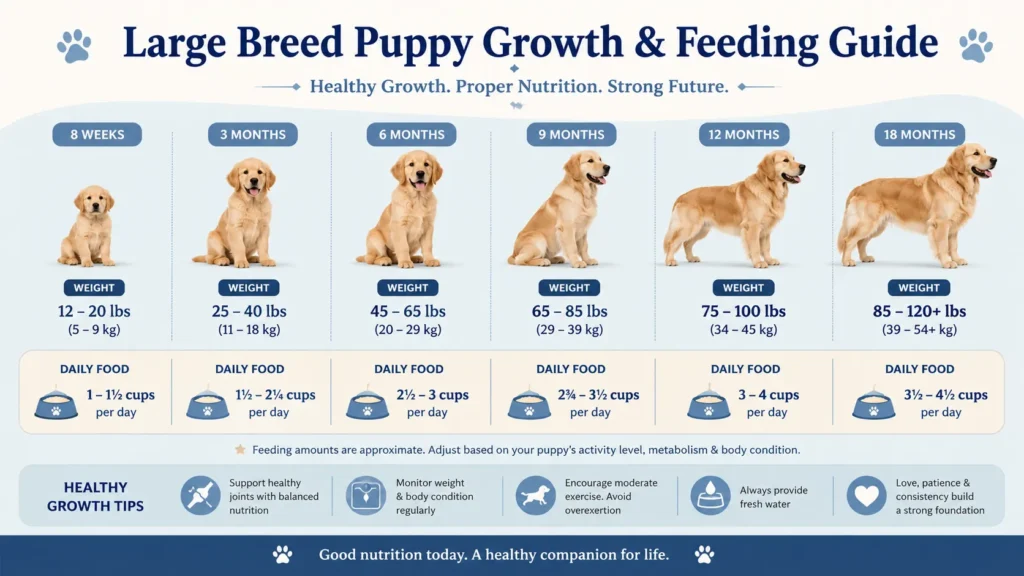
The Progressive Feeding Schedule from 8 Weeks to 18 Months
Getting the feeding frequency and portion size right at every stage of the large breed puppy growth period is as important as getting the recipe right. The following schedule provides a practical framework adjusted for the specific growth milestones of large breed puppies.
8 to 12 Weeks: Four Meals Per Day
At this earliest stage the puppy’s stomach is very small, blood sugar regulation is still developing, and the digestive system is adjusting to life outside the whelping environment. Four evenly spaced meals per day prevent the blood sugar dips that cause hypoglycemia in young puppies and ensure nutrient availability is consistent throughout the rapid growth of this stage.
Daily food amount: approximately 5 to 8 percent of current body weight per day divided equally across four meals. Weigh the puppy weekly at this stage and adjust portions upward consistently as body weight increases while maintaining the body condition target of visible but not prominent ribs with a clear waist definition.
3 to 6 Months: Three Meals Per Day
By three months most large breed puppies have sufficient stomach capacity and blood sugar regulatory ability to move comfortably to three meals per day. Continue weighing every two weeks and comparing to the breed-specific growth curve to confirm appropriate growth rate.
Daily food amount: approximately 4 to 6 percent of current body weight per day divided across three meals. Monitor body condition carefully during this period as this is the most rapid growth phase for large breeds and the risk of overfeeding causing inappropriate growth acceleration is highest between three and six months.
6 to 12 Months: Two to Three Meals Per Day
From six months, two meals per day is appropriate for most large breed puppies. Some puppies with large litter sizes or very high activity levels may benefit from continuing three meals through eight or nine months. The growth rate begins to slow during this period but the growth plates remain open and vulnerable and caloric control remains important.
Daily food amount: approximately 3 to 4 percent of current body weight per day divided across two meals. Continue bi-weekly weight monitoring and adjust portions based on body condition rather than appetite. A large breed puppy at this age has a substantial appetite that consistently exceeds their actual nutritional requirements.
12 to 18 Months: Two Meals Per Day Transitioning to Adult Food
A large breed puppy approaches adult weight by 12 to 24 months, at which time you can begin feeding adult dog food. Easing the transition by gradually introducing the adult food over several days helps the digestive system adapt without stress. The exact timing of the transition to adult food depends on the specific breed. Dogs in the 50 to 70 pound expected adult weight range typically complete their growth around 12 to 14 months. Giant breeds including Great Danes, Saint Bernards, and Bernese Mountain Dogs may continue growing until 18 to 24 months and should remain on large breed puppy food until growth plate closure is confirmed. Chewy
Daily food amount: Transition toward the maintenance amount appropriate for the dog’s expected adult weight using the feeding guidelines in Article #7 of this site as the target adult feeding level.
What to Never Add to Large Breed Puppy Food
Several additions that are appropriate and even beneficial in adult dog homemade food are specifically contraindicated in large breed puppy food due to the mineral sensitivity of this life stage.
Calcium supplements in any form including eggshell powder, calcium carbonate, bone meal, and antacid tablets must never be added to large breed puppy food without specific veterinary analysis confirming the base recipe’s calcium content and calculating a precise supplementation need. The consequences of calcium over-supplementation in large breed puppies are permanent and include osteochondrosis, angular limb deformities, and increased risk of hip and elbow dysplasia.
Vitamin and mineral supplements formulated for adult dogs are not appropriate for large breed puppies as their mineral ratios are calibrated for adult maintenance rather than for the controlled growth requirements of this life stage. Always use a supplement specifically formulated for large breed puppy growth and confirmed appropriate for use with a homemade diet.
High-fat additions including coconut oil in large amounts, full-fat meat cuts, skin-on poultry, and fatty fish as a sole protein add caloric density that promotes the excessive growth rate associated with developmental orthopedic disease in large breeds. Keep all fat sources controlled and lean throughout the entire puppy growth period.
Organ meats in large amounts, while nutritionally valuable in adult homemade food, are very high in minerals including phosphorus, copper, and vitamin A at concentrations that can disrupt the carefully calibrated mineral balance required in large breed puppy food. Use organ meats if at all in very small amounts, no more than three to five percent of the total recipe, and only when the overall mineral balance of the recipe has been professionally verified.
Supplements Essential for Large Breed Puppy Food
Large breed puppy food supplementation must be approached with more caution than supplementation for any other life stage because of the mineral sensitivity described throughout this guide. Every supplement added to a large breed puppy’s diet should be specifically approved for this life stage and used at doses confirmed appropriate for your puppy’s current weight.
A complete vitamin and mineral supplement specifically formulated for large breed puppy homemade diets is the single most important supplement in this category. These supplements are formulated to fill the nutritional gaps in a fresh food recipe while providing calcium, phosphorus, zinc, and other minerals at concentrations appropriate for large breed puppy growth without creating the excess that causes developmental problems. They are available through veterinarians and reputable pet nutrition supplement suppliers and should always be the first supplement confirmed and established before any other additions are considered.
Fish oil at a puppy-appropriate dose confirmed with your veterinarian provides the DHA essential for brain, visual, and neurological development throughout the extended large breed growth period. The dose for a large breed puppy is typically higher than for a small breed puppy due to the greater body mass requiring DHA support, and the extended growth period means DHA supplementation should continue through at least 12 months in most large breeds.
A puppy-specific probiotic supports the development of a healthy gut microbiome during the post-weaning adjustment period and throughout the active immune system development of the first year. A diverse and well-populated gut microbiome established in the puppy months provides immune regulatory benefits that persist throughout the dog’s adult life.
The Importance of Veterinary Nutritionist Oversight
Large breed puppy food is the single category of homemade dog feeding where veterinary nutritionist involvement is most strongly recommended before starting rather than as a fallback when problems arise. The mineral balance requirements of this life stage, the developmental consequences of getting those balances wrong, and the extended period during which errors compound make professional recipe verification genuinely important rather than just advisable.
A board-certified veterinary nutritionist can analyze the specific recipe you intend to feed using nutritional analysis software calibrated to current research on large breed puppy requirements, confirm that the calcium to phosphorus ratio is within the safe developmental range, calculate the precise supplement doses needed to address any nutritional gaps, and provide guidance on adjusting the recipe as the puppy grows through different developmental stages.
This professional analysis is a one-time investment that provides confidence throughout the entire large breed puppy growth period. The cost of a veterinary nutritionist consultation is meaningfully lower than the cost of managing a developmental orthopedic condition caused by nutritional error during the puppy growth window.
Resources including the BalanceIt tool developed with UC Davis and the services of the American College of Veterinary Nutrition provide accessible pathways to professional recipe analysis for dog owners committed to homemade large breed puppy feeding. Your regular veterinarian can also provide a referral to a board-certified veterinary nutritionist if you need guidance finding appropriate professional support.
Signs Your Large Breed Puppy Is Growing at a Healthy Rate
Monitoring your large breed puppy’s development provides the ongoing feedback needed to confirm that the large breed puppy food recipe and feeding schedule are producing the healthy, controlled growth that this life stage requires.
Appropriate weight gain tracks consistently within the breed-specific growth curve without significant exceedances above or below the expected range. Puppies growing significantly above the upper curve boundary need caloric reduction. Puppies consistently below the lower boundary may need increased portions or veterinary assessment for underlying health issues affecting growth.
Body condition at every age should show a puppy that is lean but not thin. Ribs should be easily felt under a thin layer of fat, never prominently visible, never buried under fat that prevents palpation. A waist should be visible from above and a mild abdominal tuck from the side throughout the entire growth period.
Skeletal development observed through steady, confident movement without unusual gait patterns, reluctance to put weight on limbs, or visible angular deformities of the legs is the most important physical indicator of appropriate developmental progress. Any concerning gait abnormality, limb swelling, or reluctance to bear weight warrants immediate veterinary assessment regardless of the puppy’s diet.
Coat quality, energy levels, appetite consistency, and stool quality all reflect the adequacy of the overall nutrition plan. A puppy with a glossy coat, consistent good energy appropriate for their age, a healthy appetite at each mealtime, and firm, well-formed stools is receiving nutrition that is supporting their development effectively.
Final Thoughts
Large breed puppy food demands more precision, more veterinary collaboration, and more consistent monitoring than any other category of dog feeding, and those demands are entirely justified by the lifelong consequences of getting this developmental stage right or wrong. The extra care invested in understanding the specific mineral requirements, maintaining controlled growth, providing consistent DHA support, and verifying recipe completeness with professional guidance pays dividends that last throughout the dog’s entire life in the form of sound joints, a structurally healthy skeleton, a well-developed brain, and the robust adult health that only begins in puppyhood.
Start with the recipe in this guide, confirm it with your veterinarian or veterinary nutritionist before making it your puppy’s primary food, follow the progressive feeding schedule with consistent weight monitoring at every stage, and approach every bowl you prepare with the awareness that you are building the adult dog your puppy will become.